-1.png)
EtonHouse Singapore
April 2026
Share This Article
What does it truly mean to be ready for life beyond school?
For many families, the final years of school can feel like a countdown. Subject choices, exam results, university applications, career conversations, and future plans often take centre stage. Beneath these practical decisions, however, lies a deeper question: Is my teenager truly ready for what comes next?
As explored in our recent EtonHouse Parenting Webinar, The Launch Years: Preparing Teens for Life Beyond School, readiness is not simply about having a clear plan, a confirmed university place, or a defined career path. It is about developing the confidence, self-awareness, and resilience to navigate uncertainty.
The webinar featured insights from Gabriella Schubert, alumna of Middleton International School, Rachael Blacklaws, History and Geography Teacher and University and Career Guidance Counsellor at EtonHouse International School Orchard, and was moderated by Sophia Klopp, a Positive Discipline Parenting Educator and parent within the EtonHouse community.
Together, their reflections offered an important reminder: the teenage years are not only about preparing for the next academic step. They are about helping young people understand who they are, what they value, and how they can move forward even when the path is not yet fully clear.
We often mistake certainty for readiness
Parents often feel reassured when teenagers seem to know exactly what they want to do. A chosen subject combination, a preferred university, a future profession, a carefully considered plan. Certainty can feel comforting, especially during a stage filled with deadlines and major decisions. Yet certainty is not the same as readiness.
Many teenagers are still forming their sense of identity during these years. Their interests may shift, their confidence may fluctuate, and their understanding of the world, and of themselves, continues to evolve. A teenager who is unsure is not necessarily unprepared. In many cases, they are doing the important work of exploring, questioning, and refining their thinking.
When we expect young people to have all the answers too soon, we may unintentionally create more pressure. Rather than asking teenagers to produce certainty, we can support them in developing the skills that help them make thoughtful decisions over time.
Uncertainty is not always a problem to solve
One of the most important shifts for parents is learning to sit with uncertainty alongside their teenager. When a young person does not know what they want to study, where they want to go, or what future they are working towards, it can be tempting to step in quickly with advice, solutions, or reassurance.
Yet uncertainty is not always a sign that something is wrong. It may be a sign that a young person is weighing possibilities, developing greater self-awareness, or beginning to recognise the many pathways available to them. It may also be part of the natural process of becoming more independent.
During the webinar, Gabriella reflected on how adaptability became one of the most important skills during her transition beyond school. When plans changed, including not securing on-campus accommodation, she had to pause, reassess, and work through the situation step by step. These moments are not interruptions to readiness. They are part of the process of building readiness.
Young people develop resilience not because every plan unfolds smoothly, but because they experience setbacks and learn to respond, adjust, and keep moving forward.
The real task is building decision-making muscles
As teenagers move towards adulthood, they need opportunities to practise making decisions, not simply receive decisions made on their behalf. This does not mean parents step away entirely. Rather, the adult role begins to shift from directing to guiding.
This might look like:
- Encouraging teenagers to research university or pathway options themselves
- Asking them to explain why a choice feels right
- Discussing practical considerations such as finances, location, visas, or entry requirements
- Supporting them to contact teachers, counsellors, or universities directly
- Inviting them to reflect on what they have learnt from both successes and setbacks
These may seem like small steps, but they help young people develop ownership. Decision-making is a skill, and like any skill, it strengthens through practice, reflection, and trust.
Confidence grows through ownership
Confidence is often misunderstood as something teenagers need before they take action. In reality, confidence often develops because they have been given meaningful opportunities to act.
When teenagers take responsibility for part of their journey, they begin to see themselves differently. They are no longer simply following instructions. They are participating in shaping their own future. A teenager who has practised asking questions, managing deadlines, seeking feedback, and navigating uncertainty is better prepared for life beyond school than one whose path has been carefully managed for them.
Of course, ownership does not mean teenagers are left to manage everything on their own. They still need adults who listen, guide, encourage, and provide boundaries. But they also need space to try, reflect, make mistakes, and try again. Support works best when it strengthens a young person's belief in their own capacity.
Home and school form a wider support system
The launch years can be emotionally demanding. Teenagers are managing academic expectations while also navigating friendships, identity, independence, and pressure about the future. This is why the partnership between home and school matters.
Teachers, counsellors, mentors, and families each see different parts of a young person's experience. When communication is open, support becomes more consistent and responsive. Schools also play an important role in providing opportunities beyond the classroom for students to develop leadership, independence, and resilience in authentic contexts.
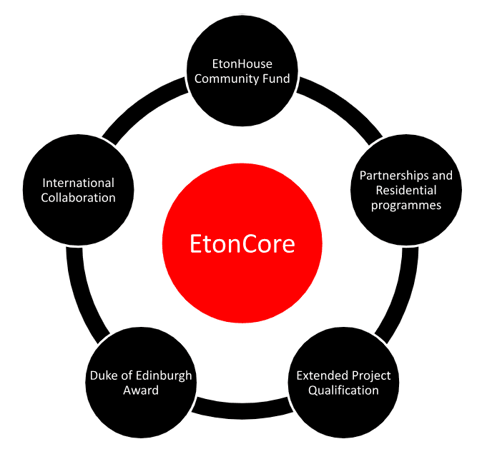
Programmes such as Duke of Edinburgh, EtonCore, volunteering, and community engagement allow students to practise responsibility, collaboration, and adaptability. These experiences help young people build more than a strong transcript. They build confidence, perspective, and a sense of contribution.
What can parents do during the launch years?
Supporting teenagers through this stage is not about having all the answers. Often, it is about creating the conditions for thoughtful growth.
Parents can support by:
- Listening before offering solutions
- Asking open-ended questions that encourage reflection
- Normalising uncertainty and changing direction
- Encouraging teenagers to take practical ownership of their next steps
- Focusing on growth, wellbeing, and self-awareness, not only outcomes
- Staying connected while gradually giving more responsibility
- Partnering with the school when additional support or perspective is needed
Perhaps most importantly, teenagers need to know that they are not expected to have everything figured out. They need to know that plans can evolve. That mistakes can be learnt from. That uncertainty can be managed. That they have people around them who believe in their ability to grow.
Readiness is the capacity to navigate what comes next
The final years of school are often framed as preparation for a specific destination: a university, a course, a career, or a next step. But life beyond school is rarely linear. The future young people entering will require adaptability, resilience, self-understanding, and the confidence to keep learning.
The young people who thrive are not always those with the clearest plans. They are often those who can ask thoughtful questions, seek support, adapt when circumstances change, and keep moving forward when the next step is not yet obvious.
Readiness is not about certainty. It is about resilience, agency, and the belief that one can navigate whatever comes next.
Discover how EtonHouse supports students in developing the confidence, independence, and sense of purpose needed for life beyond school. Book a school tour to learn more about our holistic approach to learning and well-being.
Additional Resources
You may also find these resources helpful as you support your teenager through the transition beyond school:
- What Adolescents Really Need from Parents from the Greater Good Magazine
- Universal Ingredients to Parenting Teens: Parental Warmth and Autonomy from the Scientific Reports
- Untangled by Lisa Damour
- The Emotional Lives of Teenagers by Lisa Damour
- How to Raise an Adult by Julie Lythcott-Haims
Discover how EtonHouse supports teenagers in developing the confidence, resilience, independence, and sense of purpose needed to navigate life beyond school with clarity and self-belief.